


Zairyu Card (Residence Card) Japan 2026: What It Is & New Rules

A zairyu card (在留カード), or residence card, is the official ID card for foreign residents in Japan. The Immigration Services Agency, under the Ministry of Justice, issues it to medium to long-term residents. You get one if you stay in Japan for more than 3 months.
The residence card serves as proof of your residency status and your current address. Residents aged 16 and over must carry it at all times. It replaced the old alien registration card, often called the gaijin card, on July 9, 2012.
Cards issued from June 14, 2026 use a new design that moves some details to the IC chip. This guide covers how to get a card, what it shows, what to do if you lose it, and how to keep it current.
What is a zairyu card?

Japanese residence card (zairyu card) sample, design used before June 14, 2026
A zairyu card is the residence card for foreign nationals staying in Japan for more than 3 months. It is an important document in everyday life. Foreigners need it for a bank account, a lease, public services and most administrative procedures.
Key facts about the zairyu card
Japanese name |
在留カード (zairyu kado) |
Who gets one |
Medium to long term residents staying more than 3 months |
Who issues it |
The Immigration Services Agency of Japan, under the Ministry of Justice |
Where you get it |
At major airports on arrival, or by mail after you register your address |
Carry rule |
Required for residents aged 16 and over; fines of up to ¥200,000 |
Replaced |
The alien registration card (外国人登録証明書), in July 2012 |
New design |
Cards issued from June 14, 2026 store some details on the IC chip |
What the card shows
Your name, date of birth, sex and nationality
Your photo
Your address, on the back
Your residency status and any work restrictions
The expiration date of your period of stay
Your card number and its expiry date
On new cards, the length of your stay, the permission type and the issue date move to the IC chip. Use the Immigration Services Agency's free card reader app to see them.
What a zairyu card is not
Not a visa. It shows the resident status you hold. Your legal permission to stay is the status, not the card.
Not proof of nationality. It only shows that you are a foreign resident legally in Japan.
Not a special permanent resident certificate. Special permanent residents receive a separate certificate under a different law.
Not a passport. You still need your passport to travel and for most immigration procedures.
Not your resident record. Your city hall keeps the resident record (住民票, juminhyo) after your resident registration.
With your zairyu card, you can open a bank account and sign rental contracts. Residents aged 16 and over must carry it at all times.
How do I get a zairyu card?
Most people get their card on arrival. You first need a long-term visa, usually based on a Certificate of Eligibility from the immigration bureau.
At the airport
Immigration officials issue the card at these airports when you land:
Narita, Haneda, Chubu and Kansai
New Chitose, Hiroshima and Fukuoka
Bring your passport and visa. The officer stamps your passport and hands you the residence card.
By mail, after you register your address
If you arrive at another port, you will not receive the card on the spot. Instead, register your address at your local municipal office within 14 days of moving in. Immigration then mails the card to your registered address.
Who doesn’t get a zairyu card?
These foreign nationals do not receive a residence card:
Short-term visitors: tourists and business visitors, including those on a Japan eVISA
Anyone granted 3 months or less: their period of stay is too short
Diplomatic and official visa holders
Special permanent residents: they receive a special permanent resident certificate instead
Digital nomads: holders of the Japan digital nomad visa are not medium to long-term residents
The new residence card from June 14, 2026
Japan started issuing redesigned residence cards on June 14, 2026. Existing zairyu cards stay valid until their expiration date, so you do not need to swap yours early.
What changed on the card
Still printed: your name, residency status, work restrictions and the expiration date of your period of stay
Moved to the IC chip: the length of your stay, the permission type, the permission date and the issue date
New PR card validity: permanent resident cards for adults now last until the 10th birthday after issue
Photos: children aged 1 and over now need a photo on their card
To read the chip, use the Immigration Services Agency's free card reader app. Employers and landlords can use the same app to check that a card is real.
The Specified Residence Card
You can also choose a Specified Residence Card (特定在留カード). It combines your zairyu card and your My Number card, which holds your individual number. It is optional. Japan issues individual numbers to every registered resident, foreigners included.
Benefits:
One card for ID, social security and your health insurance
You update one card when you move, instead of two
It takes about 10 days longer to issue.
👉See how the My Number card and residence card merger works.
What if I lose or damage my zairyu card?

Residence card reinsurance application sample
If you lose it or it is stolen
Report the loss to the police and note your police report receipt number.
Visit the immigration bureau that covers your address and apply in person.
Do it within 14 days of noticing the loss. If you were abroad, the 14 days start when you re-enter Japan.
Bring the following documents when submitting your application:
One photo
A loss or theft statement with your police report number, or a disaster certificate
Your passport
A family member aged 16 or over who lives with you can apply for you.
Reissue is free, and the bureau usually issues the new card the same day. To add your name in kanji, also submit the kanji name form.
If it is damaged
Apply for a replacement as soon as possible if your card is badly damaged or its IC chip fails. There is no fixed deadline, unless immigration orders you to replace it.
What happens to my zairyu card when I move within Japan?
When you move in Japan, you must update your address registration within 14 days. Submit a moving-in notification at the municipal office for your new address, and bring your zairyu card.
The office prints your new address on the back of the card. It also updates your resident record (juminhyo) and your national health insurance. Read how to register in your new city.
Late notification can bring a fine of up to ¥200,000. If you go 90 days without registering your address, immigration may cancel your status.
How do I change my residence status on my zairyu card?
To change your residency status, apply at the immigration bureau that covers your address. When immigration approves it, you receive a new residence card showing your new status.
You need to submit:
An application form
Your passport and current residence card
One photo
The required documents for your new status
Check the MOJ's change of residence status page for the documents your case needs.
Common statuses people change to
Work: the Engineer/Specialist in Humanities/International Services visa, with a Japanese employer
Starting a business: see the 3 types of visas you need to start your business in Japan
Business: the Business Manager visa, the 4-month Business Manager visa, the investor visa and the startup visa
Self-employed: the self-sponsored visa
Family: the spouse visa and the dependent visa
Young travellers: the working holiday visa, which you apply for from abroad
From October 1, 2026, a change of status costs ¥10,000 to ¥75,000, based on the period granted.
Zairyu card validity vs period of stay: what's the difference?
Many people confuse the card's expiration date with their right to stay in Japan. They are two different things.
Period of stay: your legal permission to remain in Japan under your current status
Card validity: how long the card itself stays valid
For most foreign residents, the two dates match. Permanent residents are the exception: their status never expires, but their card does.
After an extension or change of status, you receive a new card with the new expiration date. Always check that date and apply before it passes.
👉 Read also: Visa Renewal Japan 2026: Fees, New October Fee Table & How to Apply
How do I renew my zairyu card?
You renew the card by extending your period of stay. Apply at the immigration bureau that covers your address, not any bureau.
When: from 3 months before your stay expires, for stays of 6 months or more
Where: at the bureau, or online with a My Number Card
Fee: ¥10,000 to ¥75,000 from October 1, 2026, based on the new period granted
Permanent residents: renew only the card, free, from 3 months before it expires
You need to submit an application form, your passport, your current residence card, a photo and the documents for your status. Check MOJ's renewal application procedures for your status.
👉 For the full step-by-step process, read our residence card renewal guide.
How can I get permanent residence in Japan?
When you have lived in Japan long enough, you can apply to become a permanent resident. PR in Japan removes limits on your work and length of stay.
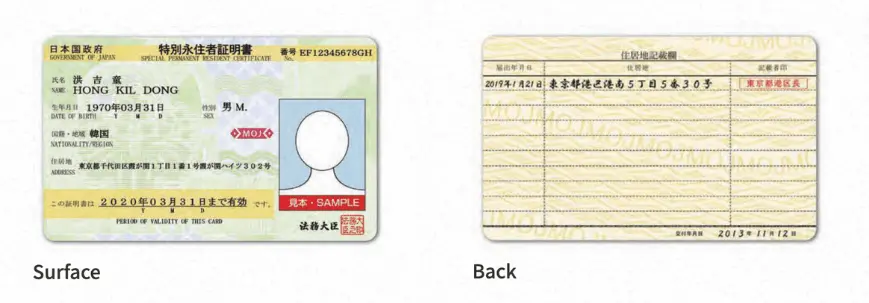
Permanent resident residence card (example)
Who can apply
Standard route: 10 years of continuous residence
Highly skilled route: 3 years at 70 points, or 1 year at 80 points
All applicants: a stable life, no criminal record and full tax and social security payments
How to apply
Apply at the immigration bureau that covers your address. Bring the PR application form, your passport, your current residence card, a photo and the required documents.
Check MOJ's PR application procedures for the full list. From October 1, 2026, the fee is ¥200,000, paid when immigration approves you. Processing often takes several months.
After years as a permanent resident, some people go further. See how to get citizenship in Japan.
👉 Read also: Japan Immigration News: What Every Foreign Resident Needs to Know
What happens to my zairyu card if I leave Japan temporarily?
Take your passport and a valid zairyu card when you leave Japan for a trip. The special re-entry permit only works if your card is valid when you depart. To keep your status, you need one of two re-entry permits:
Special re-entry permit: for trips of up to 1 year, or until your period of stay ends if that is sooner. Tick the box on the embarkation card at the airport. See our guide to leaving Japan for a couple of months.
Re entry permit: for longer trips, valid for up to 5 years but not past your period of stay. Apply at the immigration bureau before you leave.
If you leave without either permit, you lose your status. You then need a new visa to re enter Japan.
What happens if I leave Japan permanently?
If you leave Japan for good, you must return your zairyu card. Hand it to immigration officials at the airport or seaport when you depart.
Before you go, file a moving-out notification at your municipal office. It closes your resident record and your national health insurance.
Do I have to carry my zairyu card?
Yes, if you are 16 or older. You must carry your card at all times and show it when police or immigration officials ask.
Breach |
Possible penalty |
|---|---|
Not carrying your card |
Fine of up to ¥200,000 |
Not registering a new address within 14 days |
Fine of up to ¥200,000 |
Not registering an address for 90 days |
Your status may be cancelled |
Lending or borrowing a card |
A criminal offense for both people |
Can my zairyu card show my name in kanji?
Yes. If your name uses Chinese characters, you can ask for kanji on your card next to the Roman letters. Submit the kanji name form when you apply for a new or renewed card.
Frequently asked questions
What is the meaning of a zairyu card?
A zairyu card (在留カード) is a residence card for foreign nationals living in Japan for more than 3 months. "Zairyu" means residence or stay. The card proves your identity, address and residency status.
What does a zairyu card look like?
It is a plastic ID card with your photo, name, nationality and residency status on the front. Your address prints on the back. Cards issued from June 14, 2026 use a new design that stores some details on the IC chip.
How long is the zairyu card valid?
Most cards are valid until your period of stay ends. That can be 1 year on a working holiday visa or up to 5 years on a spouse visa. Permanent resident cards for adults issued from June 14, 2026 last until the 10th birthday after issue.
Do you need to return your residence card when leaving Japan?
Only if you leave Japan permanently. Hand it to immigration officials at the airport or seaport. For a temporary trip, keep it and use a re-entry permit so you keep your status.
Can you re-enter Japan with an expired residence card?
If your period of stay has expired, your status has ended, so you cannot re-enter on it. Permanent residents keep their status when the card expires. Still, they should renew the card before a trip if it will expire while they are away.
Is a zairyu card the same as my resident record?
No. Your local municipal office creates your resident record after you complete resident registration. That address then prints on the back of your zairyu card. The two are linked but serve different purposes.
Do I need my zairyu card to apply for a My Number card?
Yes. You present your zairyu card when you apply for a My Number card, which carries your individual number. Since June 14, 2026, you can also combine both into one Specified Residence Card.
Can I update my address or family information on my zairyu card?
Yes. Report a new address at your municipal office within 14 days. Changes to your name, nationality or other card details go to the immigration bureau, also within 14 days.
Is the zairyu card the same as the gaijin card?
No, but it replaced it. The old alien registration card, often called the gaijin card, ended in July 2012. The zairyu card took its place for medium to long term residents.
What happens if I don't carry my zairyu card?
Residents aged 16 and over must carry it at all times. Failing to carry it can bring a fine of up to ¥200,000. Lending your card to someone else is also a crime.
In closing
Your zairyu card is the most important document for living in Japan. Other IDs include your driver's license, My Number Card and health insurance card.
Carry your card every day, update your address within 14 days, and renew before the expiration date.
Sources
Spending too long figuring out your Japanese mail?
Virtual mail + translation services start at 3800 per month. 30-day money-back guarantee.